


Services
Apostille & Document Legalization for Global Trade

Apostille & Legalization for International Trade Documents
When doing business internationally, many countries require foreign documents to be formally authenticated before they will be accepted by Customs authorities, regulators, banks, or courts. This process—known as Apostille🔊 or consular legalization, depending on the specific process—confirms that your documents are authenticated by a recognized authority.
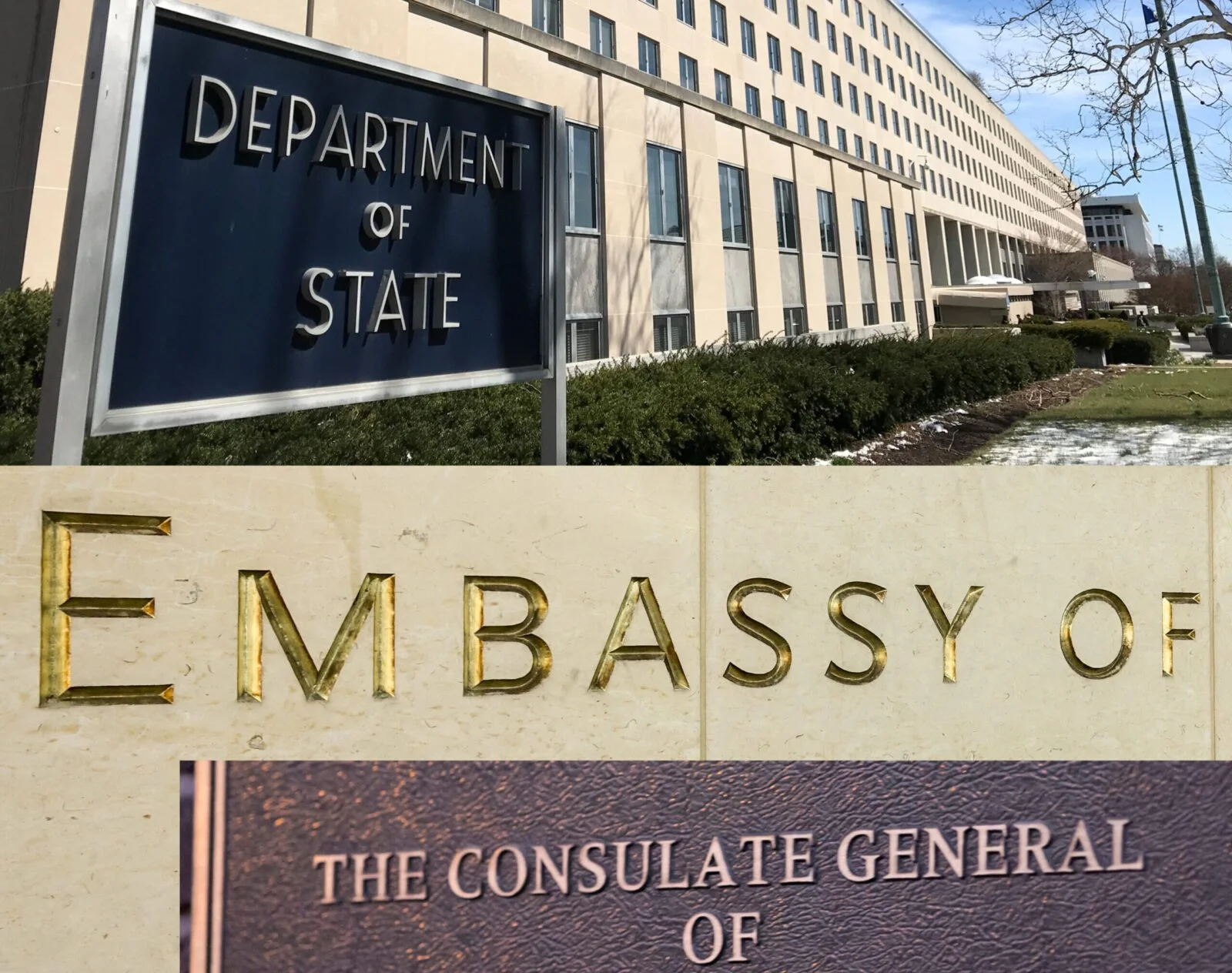
For countries that are members of the Hague Apostille Convention , authentication is completed through a standardized apostille process. Countries outside the Convention require consular legalization, a multi-step process culminating in approval by the destination country’s embassy or consulate in the USA. Requirements and timelines vary by country and document type. Timelines for all countries and territories can be found on our Consular Legalization and Apostille page.
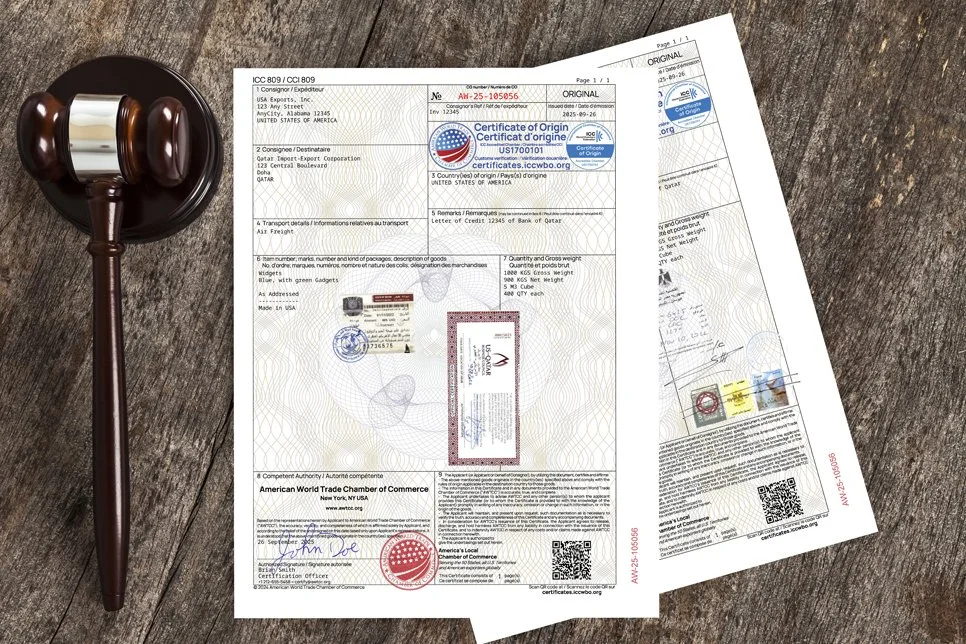
Through the Chamber Certification platform, exporters can submit documents electronically and have apostille or legalization handled by the experts at the American World Trade Chamber of Commerce, helping ensure documents are prepared correctly and accepted abroad.
Register once to submit export document applications electronically through a participating U.S. Chamber.
For new company accounts only. Existing companies: ask your administrator to add you or contact support@chambercertification.com

Legalization or Apostille?
Most countries (including the United States) are signatories to the Convention of 5 October 1961, Abolishing the Requirement of Legalisation for Foreign Public Documents, commonly known as the Hague Apostille Convention. For these countries, documents are authenticated through a standardized and streamlined process called an Apostille , which replaces traditional embassy legalization.
Countries that are not signatories to the Hague Apostille Convention require documents to be legalized by the U.S. embassy or consulate of the destination country. This is a multi-step administrative process that typically involves certification by various authorities and culminates in final approval by the destination country’s embassy or consulate in the United States. Requirements vary by country, document type, and intended use. While the process can be complex, documents submitted electronically through the Chamber Certification platform can be managed end-to-end by the experts at the American World Trade Chamber of Commerce.
Types of Business Documents Commonly Legalized or Apostilled
Commercial Documents (typically related to export shipments)
Certificates of Origin
Commercial Invoices
Legal and Regulatory Documents (often required for product registration, regulatory approval, or representation)
Health Certificates
Good Manufacturing Practice (GMP) Certificates
Trade Licenses
Powers of Attorney
Intellectual Property Documents
Contracts and Agreements
Court-Issued Legal Documents
Government-Issued Documents
U.S. FDA Export Certificates
State or Federal Health Certificates
Patents and Trademarks
Timeframe for Processing
Processing times vary widely depending on the destination country, document type, and required authentication method. Legalization or apostille for many countries can often be completed in under two weeks; however, some countries’ embassy legalization procedures may take several months, in certain cases up to three or four months. For documents originating in the United States, estimated processing timeframes for most countries are published on our site.
Glossary of terms related to Legalization and Apostille
Confused about this complex process? You’re not alone! We have put together a glossary of terms as used in the Apostille and Legalization process, which many find helpful in navigating this process - although the simplest way to navigate this process is through the experts at AWTCC using the Chamber Certification platform.
-
Affidavit: A sworn statement made in writing, often used as evidence in legal proceedings.
Airway Bill: A legal document between a shipper and a carrier detailing the type, quantity, and destination of the goods being carried. Not a legal title document to the goods.
Apostille: A form of authentication issued to documents for use in countries that participate in the Hague Convention of 1961.
Attestation: A formal confirmation by a trusted third party that a document, signature, or statement is authentic and was properly issued or executed, based on a review of the information presented.
Authentication: The process of certifying a document so that it will be recognized by the legal system of a foreign country. This is the ultimate purpose of both Apostille and Legalization).
-
Bill of Lading: A legal document between a shipper and a carrier detailing the type, quantity, and destination of the goods being carried. Serves as a legal title document to the goods.
-
Certificate of Free Sale: A document that indicates that a particular product is sold freely in the country of export. Often required by importers or regulatory authorities in the importing country as evidence that the product complies with regulations, safety standards, and other requirements. The certificate, issued based on exporter’s declarations, typically helps assure that the product is freely sold in the market of export, and therefore does not represent an undue risk, and is approved for sale and exportation. A Certificate of Free Sale is issued by a competent authority (which can be a government agency, Chamber of Commerce, or other authorized entity depending upon the product).
Certificate of Origin: A document declaring the origin of the goods being exported, often needed for customs purposes and/or statistical purposes. ‘Origin’ refers to country of manufacture or production.
Commercial Documents: In the context of Legalization, generally refers to documents utilized in an export transaction, such as certificates of origin and commercial invoices, as well as packing lists, ocean bills of lading or airway bills, etc.
Commercial Invoice: A bill for the goods shipped from the seller to the buyer, usually required also for customs clearance to establish value.
Consular Authentication: A specialized form of document legalization involving verification by a consulate or embassy.Consular Legalization: A method of document authentication for countries that are not signatories to the Hague Convention. This involves getting a document verified by the consulate of the country where the document will be used.
Consulate: An office representing a country within another country but is not the main diplomatic mission (which is the embassy).
-
Department of State: Each U.S. state and territory has a Department of State. One of the functions of this state government agency is the authorization of Notary Publics, and of authenticating the validity of their notarial acts (notarizations) by Authentication or Apostille - see definitions above. (Also see U.S. Department of State).
Diplomatic Channels: The official pathways through which documents may need to be authenticated, usually involving various ministries and embassies.
Document Declaration: A declaration by a Chamber of Commerce attesting to the fact that a presenter of a document has certified the genuineness of that document to the Chamber, and the Chamber’s recording of that document in a permanent, non-alterable format.
Document Rivet: A method of physically securing, with a brass rivet, multiple pages of a paper document together to help prevent tampering or alteration.
Due Diligence: Comprehensive verification or audit of a document to ensure that all legal requirements are met.
-
Embassy: The official diplomatic representation of one country in another country.
Embassy Authentication: A specialized form of document authentication that involves verification by an embassy. Embassy authentication is generally preceded by other administrative requirements; depending on the country involved, these processes could include notarization, Chamber of Commerce certification, county and or state/territory authentication, and/or U.S. Department of State authentication.
Export License: A government-issued document authorizing the export of controlled goods in specific quantities to a particular destination country that is under restrictions from the U.S. Government.
-
Freight Forwarder: A service provider that arranges the shipping (by air or ocean), Customs clearance, and related documentation for exported goods.
-
Government Documents: In the context of Legalization, this generally refers to documents issued by a national or regional (such as a state or province) government agency. This would include government issued health or veterinary certificates, food and drug related certificates, licenses or permits, export licenses, court orders, etc.
-
Hague Apostille Convention: An international treaty first signed in 1961 that simplifies the process of authenticating public documents for use across signatory countries.
The formal name for the Hague Apostille Convention is: Convention of 5 October 1961 Abolishing the Requirement of Legalisation for Foreign Public Documents -
Incoterms: Incoterms® (short for International Commercial Terms) are a standardized set of trade rules published by the International Chamber of Commerce (ICC). They define the responsibilities of buyers and sellers in international (and domestic) sales contracts—specifically who does what, who pays for what, and when risk transfers for the delivery of goods (e.g., transport, insurance, export/import formalities).
They do not cover price, payment terms, or transfer of ownership; their role is to eliminate ambiguity in shipping and logistics obligations.
The latest and current edition in force is Incoterms 2020 (effective since 1 January 2020).
Incoterms are published by the International Chamber of Commerce (ICC). A copy and learning materials may be obtained from the ICC Bookstore.
-
Jurat: A clause at the end of an affidavit or other document indicating when, where, and before whom the document was sworn or affirmed.
-
Kyoto Convention: An international treaty first signed in 1939 and updated periodically since then; not directly related to the legalization or authentication of documents used in international trade, but a significant international instrument dealing with customs procedures. Specifically, the "International Convention on the Simplification and Harmonization of Customs Procedures" - Kyoto Convention - is a World Customs Organization (WCO) treaty that aims to simplify and harmonize international customs procedures across its member countries and nominates Chambers of Commerce as a preferred issuer of Certificates of Origin.
-
Letter of Credit: A document issued by a bank effectively guaranteeing payment to a seller based on specified conditions. As used in international trade, meeting the specified conditions is evidenced by documentary compliance.
Legal Documents: In the context of Legalization, this generally refers to documents utilized in international trade (though not necessarily related to an individual shipment of goods), such as privately issued (not issued by a government agency) health certificates, trade licenses, power of attorney documents, intellectual property documents, contracts and agreements, etc.
Legalization: The process of officially obtaining certification of a document through an embassy or consulate so that it will be recognized by the legal system of that country.
-
Notarization: The act of officially certifying a document’s signatory by a notary public.
Notary Public: an official of integrity appointed by the government to serve the public as an impartial witness in performing a variety of official fraud-deterrent acts related to the signing of important documents.
NUSACC: National U.S. – Arab Chamber of Commerce, an organization that facilitates trade and investment between the United States and Arab League countries.
-
Power of Attorney: A legal document authorizing one person to act as the legal representative of another.
Proforma Invoice: An initial invoice sent by a seller to a buyer in advance of a shipment or delivery of goods, often for customs or import purposes as a preliminary price quotation.
-
Sanitary and Phytosanitary Measures (SPS): Certifications to indicate that food, plants, or animals meet certain health and safety standards.
Shippers Letter of Instructions: Often referred to as an SLI, a summary of cargo to be shipped, including the origin, destination, value and instructions regarding the shipping process.
State Authentication: The process of having a document authenticated by a state-level authority, usually before undergoing further federal or international authentication.
-
Tariff: A tax or duty to be paid on specific imports.
Trade Compliance: The practice of adhering to laws, regulations, and best practices that govern international trade.
-
U.S. Department of State: Sometimes referred to as USDOS, the federal executive department responsible for carrying out U.S. foreign policy and international relations, which is also responsible for federal-level Authentication or Apostille of documents.
US – Qatar Business Council: The US - Qatar Business Council is an organization that aims to support economic partnership and trade relations between the United States and Qatar. The council is involved in one of the steps in the legalization of documents destined for Qatar (and part of the process managed by AWTCC for companies using our services).
-
Verification: The act of ensuring that a product, service, or document complies with established rules, standards, or laws.