

Services
Certificates of Free Sale


Chamber-Issued Certificates of Free Sale (CFS)
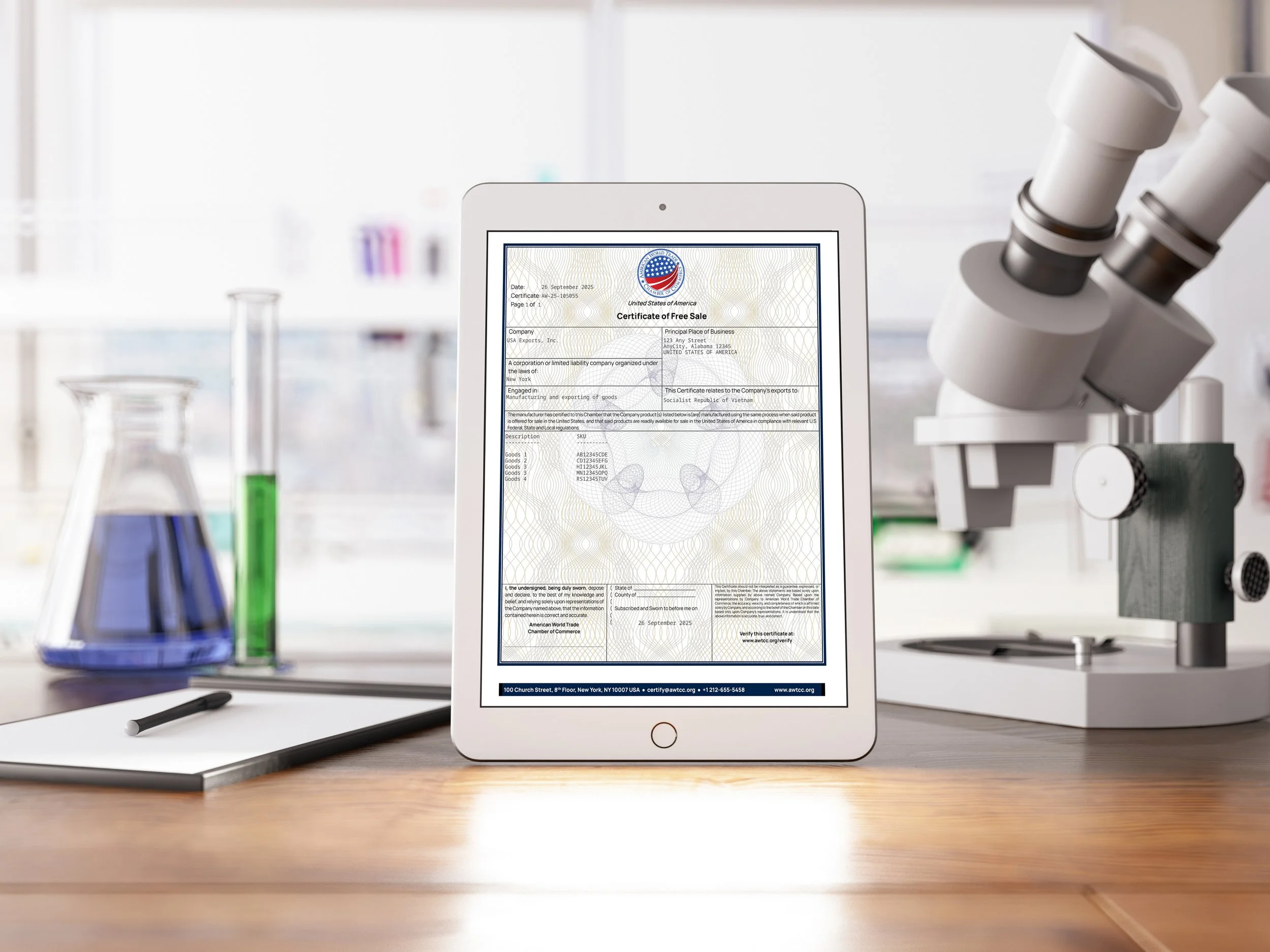
The American World Trade Chamber of Commerce (AWTCC) is a leading U.S. provider of Chamber-issued Certificates of Free Sale. AWTCC provides its Certificate of Free Sale program through the Chamber Certification platform, trusted by hundreds of Chambers and thousands of exporters nationwide, which provides a standardized, secure, and traceable framework for certificate application, review, and issuance.
Certificates of Free Sale processed by AWTCC for eligible companies are commonly used to support regulatory review by foreign authorities, importers, and distributors—particularly for food, cosmetics, medical devices, supplements, and other consumer or regulated products.
AWTCC is committed to facilitating U.S. exports by providing a trusted, efficient, and internationally recognized Chamber-issued Certificate of Free Sale process through its network of participating Chambers.
Register your company for an account to submit Certificate of Free Sale, Certificate of Origin, or Apostille/Legalization applications electronically.
For new company accounts only. Existing companies: ask your administrator to add you or contact support@chambercertification.com

Top 10 FAQs About U.S. Chamber-Issued Certificates of Free Sale
-
A Chamber-issued Certificate of Free Sale (CFS) attests to the exporter’s declaration that the listed products are legally manufactured and freely sold in the United States.
Foreign regulators, Customs authorities, and importers commonly rely on a CFS as part of product registration, market-access review, or import clearance in the destination country. Once issued, the Certificate is recorded by the issuing Chamber and retained as a permanent record, supporting traceability and routine administrative or regulatory review. -
Foreign regulatory authorities often require a CFS to confirm that products exported from the United States are lawfully placed on the market and freely sold in the United States, regardless of where the products were manufactured. This is common for regulated or consumer-facing products such as cosmetics, food items, dietary supplements, medical devices, and personal care products.
-
In the United States, Certificates of Free Sale may be issued by Chambers of Commerce, federal regulatory agencies, or state authorities, depending on the product and destination requirements.
Chambers of Commerce commonly issue Certificates of Free Sale as a trade facilitation service for exporters where no specific regulatory authority is mandated. This reflects long-standing commercial practice and international expectations that Chambers serve as neutral, third-party issuers of export documentation. In many countries, buyers may require a Certificate of Free Sale by Apostilled or Legalized, which add a government authentication to the notarization on the document. In some cases, buyers or regulatory agencies may request that a CFS be issued directly by an agency of government; scroll down toward the bottom of this page to the Certificate of Free Sale (CFS) — Issuing Authority Comparison Chart for more information.
In the United States, American World Trade Chamber of Commerce issues Certificates of Free sale for exporters through the the United States on behalf of hundreds of local, regional and state chambers via the Chamber Certification platform. -
No. A Chamber-issued Certificate of Free Sale is distinct from certificates issued by regulatory authorities such as the U.S. Food and Drug Administration (FDA) or state agencies.
Acceptance requirements vary by product type, the regulatory authority involved, and the destination country. Some importing countries accept a Chamber-issued CFS for certain products, while others specifically require a certificate issued by a federal or state regulatory body.
Exporters should confirm the required issuing authority with the importer or the relevant regulator in the destination country based on the specific product being exported.
Scroll to the bottom of this page for an Issuing Authority Comparison Chart. -
Exporters apply by submitting company information, product details, and supporting documentation through a U.S. chamber.
Many chambers enable processing of Certificates of Free Sale electronically through the American World Trade Chamber of Commerce via the Chamber Certification platform, allowing exporters to register once and submit applications online for review and issuance. -
Typical requirements include exporter details, a product list, confirmation that the products are sold in the United States (typically, by providing copies of invoices demonstrating sale of the product to at least two other U.S. customers), and sometimes supporting documentation such as product labels or manufacturers’ declarations, depending on the nature of the goods and destination requirements.
-
No. Chambers do not evaluate or certify compliance with foreign regulatory requirements. Certificates of Free Sale are issued based on the exporter’s declarations and submitted documentation, in accordance with applicable Terms and Conditions. Exporters remain responsible for ensuring that their products meet all regulatory requirements in the destination country.
-
Many U.S. Chambers offer same-day or next-business-day processing, depending on application completeness and review requirements. For complete applications submitted through the Chamber Certification platform, certificates are typically processed on the same day.
-
Fees vary by Chamber and may depend on factors such as membership status, document type, or processing speed, and are typically assessed per document. At many Chambers, member companies receive discounted rates. For applications submitted through the Chamber Certification platform, applicable fees are clearly displayed for each document before submission.
-
In most cases, no. While Certificates of Free Sale are commonly applied for and processed electronically, many foreign regulatory authorities require a notarized, paper Certificate of Free Sale bearing an original signature and raised or embossed seal.
For Chamber-issued Certificates of Free Sale processed through the Chamber Certification platform, the application and review are completed electronically. Once approved, the Certificate is printed by the issuing Chamber, signed by the authorized certification officer, notarized, and issued with a raised seal, as required. Certificates can also be processed for Apostille or Embassy/Consular Legalization.
The finalized document is then sent to the exporter by courier service for submission to the destination authority.
The FAQs above cover the most common Certificate of Free Sale questions. The Deep Dive FAQs below provide more detailed guidance on when a Certificate of Free Sale is required, who may issue one, and how these documents are reviewed by foreign regulatory and Customs authorities.
Where relevant, references are made to the Chamber Certification platform as the standardized system used by participating Chambers of Commerce throughout the United States to submit, issue, and review Chamber-issued Certificates of Free Sale. Requirements vary by product and destination, and exporters remain responsible for the accuracy of all declarations.
Certificate of Free Sale (CFS) – Deep Dive FAQs
1. The Basics
-
A Certificate of Free Sale (CFS) is an export document stating that the products listed are legally manufactured and freely sold in the country of export, typically the United States. A CFS is commonly used by foreign regulators, importers, and distributors as part of product registration, import approval, or regulatory review processes.
Unlike a Certificate of Origin, a CFS does not determine tariff treatment or origin. Instead, it addresses regulatory marketability—whether the products are lawfully sold in their market of export.
-
Many importing countries require a Certificate of Free Sale to confirm that products entering their market are legally sold in the exporting country. This is especially common for regulated or consumer-facing goods, where authorities rely on the exporting country’s market controls as part of their own review process.
In practice, CFS requirements are often encountered in countries where local regulatory frameworks differ from, or are still developing relative to, those in the United States. In these cases, regulators may rely on evidence of lawful sale in the exporting country as a proxy for regulatory oversight when reviewing imported products.
A CFS helps foreign authorities assess product legitimacy, regulatory context, and market history before granting import permission.
-
A Certificate of Free Sale may be required or relied upon by:
Foreign regulatory authorities
Importers and distributors
Product registration agencies
Customs authorities (in regulated product categories)
The specific requirement depends on the destination country, product type, and regulatory framework.
-
No. A CFS is required only when mandated by the importing country’s regulations, the importer or distributor, or a specific registration or licensing process. Many exports do not require a CFS at all, while others may require different issuing authorities depending on product type.
Exporters should always confirm requirements with the buyer/importer or destination authority.
2. When a CFS Is Needed
-
CFS requirements are most common for:
Cosmetics and personal care products
Food and beverage products
Dietary supplements
Medical devices and health-related goods
Consumer products subject to foreign regulatory review
In addition, a CFS is potentially required for a whole range of products and manufactured goods, depending upon jurisdiction; therefore it is important to coordinate with your buyer/importer.
Requirements vary widely by destination country and product category. Exporters should always confirm requirements with the buyer/importer or destination authority.
-
No. There is no universal rule. Some countries require a CFS for specific product categories, others accept alternative documents, and some do not require a CFS at all. Even within the same country, requirements may differ by regulator or product classification.
Exporters should always confirm requirements with the buyer/importer or destination authority.
-
Not necessarily. Some countries require a CFS only for initial product registration, while others may require one for each shipment or for periodic renewals (for example, annual). Requirements depend on local regulations and administrative practices.
Exporters should always confirm requirements with the buyer/importer or destination authority. -
Generally, no. Free trade agreements focus on tariff treatment and origin rules, not regulatory marketability. A CFS may still be required even when goods qualify for preferential tariff treatment under a trade agreement.
3. Issuance & Authority
-
Certificates of Free Sale in the U.S. may be issued by:
Chambers of Commerce
Federal regulatory authorities (e.g., US FDA)
State government agencies
The correct issuing authority depends entirely on the importing country’s requirements and the product category involved. (See our Issuing Authority chart at the bottom of this page).
Exporters should always confirm requirements with the buyer/importer or destination authority. -
Chambers issue Certificates of Free Sale as a neutral, third-party attestation based on exporter declarations and supporting documentation. This reflects long-standing commercial practice and provides foreign authorities with a recognizable and traceable document issued through a structured process.
Once issued, a Chamber-issued Certificate of Free Sale is recorded in the Chamber’s official records in a non-alterable form, supporting document integrity, traceability, and administrative auditability.
In practice, Chamber-issued CFS documents are widely used and accepted where the importing country does not expressly mandate issuance by a specific government regulatory authority.
-
A Chamber-issued CFS attests that products are freely sold in the U.S. based on exporter declarations and supporting documents.
An FDA-issued CFS (or US FDA Export Certificate) reflects regulatory status within the FDA’s jurisdiction and involves agency review and registration.Some importing countries require one or the other; they are not interchangeable unless expressly accepted by the destination authority.
Exporters should always confirm requirements with the buyer/importer or destination authority. -
Generally, no. Most foreign authorities require a CFS to be issued by an independent third party or government body. Self-issued declarations are rarely accepted unless explicitly permitted by the importing authority.
4. Application Process
-
Exporters submit an application to the issuing authority with company details, product information, and supporting documentation.
Chamber Certification users process AWTCC chamber-issued CFS applications electronically through standardized platforms, allowing online submission, review, issuance, and recordkeeping.
US FDA Certificates of Free Sale for medical devices (which are called Certificates to Foreign Government) are issued via the FDA’s Export Certificate platform.
US FDA Certificates of Free Sale (a Certificate to Foreign Government or “Certificate of Exportability) for food products and supplements are issued via the the FDA’s Export Certificates for Food platform.
Most states and territories issue Certificates of Free Sale for agriculture products originating in that state; perform an online search to find the appropriate state agency. -
Applications commonly require:
Exporter identification and address
Product names and descriptions
Confirmation that products are sold in the U.S.
Supporting documents (e.g., labels, invoices, manufacturers’ declarations)
Exact requirements vary by product and destination.
-
Depending on the product, supporting documents may include:
Commercial invoices
Product labels or packaging
Manufacturer declarations
Proof of U.S. sale or distribution
Issuing bodies rely on these materials as part of their administrative review.
-
Processing times vary by Chamber, product list complexity, and the completeness of the application.
Many Chambers issue Certificates of Free Sale on the same day or the next business day when applications are complete and do not require additional clarification. Applications submitted electronically are often reviewed more quickly than those submitted in person or by courier, as supporting documents and declarations can be reviewed and recorded more efficiently.
When submitted through standardized digital workflows such as the Chamber Certification platform, complete applications are typically processed on the same day, subject to the Chamber’s review procedures. -
Having credit card issues on our platform is not common.
If your card does not work, it is generally one of two issues:
1. Your card has reached some kind of limit with your bank; please contact your bank directly.
2. You are using a company issued “P-Card” (Visa, Mastercard or American Express purchasing card). The card likely has restrictions on its use. Please provide this document to your accounting or finance department to allow use of your company P-Card with our platform.
5. Meaning & Limitations
-
“Freely sold” generally means that the product is legally offered for sale in the United States without regulatory prohibition. It does not mean that the product is approved, endorsed, or certified by the issuing body for use in any country.
Unlike a Certificate of Origin, a CFS does not determine tariff treatment or origin. Instead, it addresses regulatory marketability—whether the products are lawfully sold in their market of export.
-
No. A CFS does not certify product safety, efficacy, or compliance with foreign regulations. It reflects the product’s sale status in the U.S. based on the exporter’s declarations.
-
No. Foreign authorities retain full discretion to accept, reject, or request additional documentation regardless of a CFS. Acceptance depends on local laws, product classification, and regulatory interpretation.
6. Costs & Validity
-
Fees vary by chamber and may depend on factors such as membership status, document type, or processing speed, and are typically assessed per document. At many chambers, member companies receive discounted rates.
For applications submitted through the Chamber Certification platform, applicable fees are clearly displayed for each document before submission. -
This depends on the issuing authority and destination requirements. Some CFS documents cover a list of products, while others may be shipment- or product-specific.
Exporters should always confirm requirements with the buyer/importer or destination authority. -
There is no universal validity period. Validity depends on the importing authority’s rules and often varies by product. Typical validity periods range from a fixed term (e.g., one or two years) to acceptance for a specific registration or shipment.
Exporters should always confirm requirements with the buyer/importer or destination authority.
7. Corrections & Compliance
-
In practice, Certificates of Free Sale generally cannot be amended once issued. At the time of approval, the Certificate is electronically filed in a non-alterable format within official certification and verification systems. As a result, even minor changes typically require the original Certificate to be formally canceled and a new Certificate of Origin issued.
The Chamber Certification platform allows exporters to generate a pre-submission preview for internal review or buyer approval, which can help identify errors before the Certificate of Free Sale is issued and avoid the need for reissuance. -
Incorrect information on a Certificate of Free Sale may lead to shipment delays, rejection, suspension of product registration, or other regulatory action by importing authorities. Exporters remain responsible for the accuracy of all statements and supporting information submitted in connection with a Certificate of Free Sale.
If an exporter discovers an error after issuance, the exporter should promptly notify all parties who received the Certificate of Free Sale, including the buyer, importer, or distributor, and submit a new application with corrected information. Where applicable, the original Certificate of Free Sale should be formally canceled and replaced.
Prompt notification is particularly important because importers and regulators may rely on Certificates of Free Sale as part of their regulatory and compliance records. Regulatory authorities and, where applicable, customs authorities may review Certificates of Free Sale during product registration, import review, or post-market or post-clearance verification processes, which in some jurisdictions may occur months or years after the initial import or approval.
-
Penalties vary by jurisdiction and may include delays, refusal of product registration, or increased scrutiny of future applications.
8. What This Does Not Mean
-
Issuance of a CFS does not constitute approval, endorsement, or certification of a product by the issuing authority.
-
Issuing bodies do not audit manufacturing processes, test products, or independently verify regulatory compliance beyond reviewing submitted documentation.
-
Foreign regulators retain full discretion to apply their own laws and procedures, regardless of whether a CFS has been issued.
Certificate of Free Sale (CFS) — Issuing Authority Comparison Chart
Feature / Purpose |
Chamber-Issued CFS |
FDA-Issued CFS |
State-Issued CFS |
|---|---|---|---|
| Issuing authority | American World Trade Chamber of Commerce (via participating local Chambers) | U.S. Food and Drug Administration (US FDA) |
State government agency (e.g., Department of Health or Agriculture) |
| Primary purpose | Confirms exporter’s declaration that products are legally manufactured and freely sold in the United States | Confirms regulatory status of FDA-regulated products | Confirms in-state registration, licensing, or sale of specific products |
| Typical products | Cosmetics, consumer goods, supplements, food products, personal care items, and other non-prohibited goods | FDA-regulated products (e.g., foods, medical devices, biologics, some cosmetics) | Products regulated at the state level (varies by state and product type) |
| Regulatory review performed | No regulatory assessment; issued based on exporter declarations and supporting documents | Regulatory status review within FDA’s authority | State-specific compliance or registration review |
| International acceptance | Widely accepted by many foreign authorities, importers, and distributors | Required by some foreign regulators for certain product categories | Accepted only when explicitly required by the destination country |
| Use for market access / product registration | Commonly used to support foreign product registration and import approval | Often mandatory where explicitly required by foreign regulators | Required only in limited, destination-specific cases |
| Verification & traceability | Issued by a recognized Chamber and recorded for verification | Verified directly through FDA systems | Verified through state agency records |
| Speed & availability | Often same-day or next-business-day issuance via Chamber Certification™ | Processing times vary and may be longer | Processing times vary by state |
| Cost structure | Per document; member discounts common | Federal fee structure (if applicable) | State-specific fees |
| When this is typically required | When a Chamber-issued CFS is requested or accepted by the importing authority | When the importing country specifically requires an FDA-issued certificate | When the importing country specifically requires a state-issued certificate |
| Can it replace other CFS types? | No — acceptance depends on destination requirements | No — limited to FDA jurisdiction | No — limited to state authority |