
Chamber Stamps – Today’s Landscape
Country Requirements
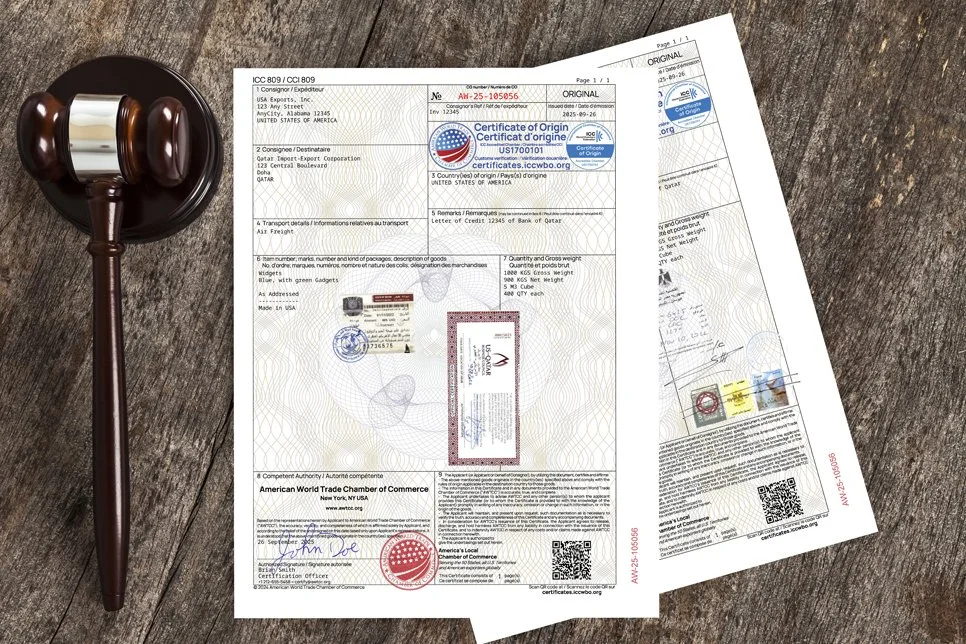
More countries are requiring stamped certificates of origin in order to access preferential treatment. We’ve seen Eastern Europe, including the Baltic states require stamped certificates of origin and we have seen that pattern extend into the Balkans in southern Europe.
Chamber stamps are more commonly being requested across Central Asia as well. The African Continental Free Trade Area, has also seen some increases in requirements for countries requesting stamped documents for any non-participant country.
Overall, global requirements for stamped certificates of origin have increased significantly. AWTCC regularly gets reports from exporters seeking chamber stamps, which have previously not faced these requirements.
While multiple factors contributed to this shift, the growth of global fraud has led to traditional methods, like chamber stamps on export documents, particularly electronically, to come back into favor. This direction seems unlikely to change.

Verification Requests
AWTCC has seen a sharp increase in requests for verification of stamped certificates of origin by parties overseas. These can include customs officials, importers, or distributors.
Retaining chamber copies of stamped certificates of origin has already been a necessary part of the process, but with increases in verification requests being able to present the chamber copy has become vital to demonstrating validity.
Verification methods, like unique QR codes on documents, are sometimes outlined as a requirement for certain industries and product types. These verification methods, along with increases in verification requests, are also fueled by the growing risk of fraud in international trade.
Certificates of Free Sale
We have seen a sharp increase in local chambers being requested to issue Certificates of Free Sale, along with items like Health Certificates or Certificates of Good Manufacturing Practices (GMP). While AWTCC does issue certificates of free sale, we are careful to ensure that the language on the certificate of free sale is precise and clear as to what the company is declaring and what the chamber is stating by certifying the document. Certificates of Free Sale often require us to require exporters to amend language to specify the exact role of the chamber in the process.
Chamber of commerce stamps are not substitutes for documents which would need to come from the FDA, USDA, or equivalent state bodies. We highly recommend chambers of commerce exercise extreme care when certifying documents outside of certificates of origin.
Consular Legalization
The additional processing done by the embassies through their consulate operations, generally referred to as legalization, seems to be sunsetting globally. Common countries requiring embassy legalization are increasingly joining the Hague Apostille Agreement. This trade barrier was historically expensive, slow, and often overly complicated for the exporter.
Vietnam has most recently signed, with the agreement going into effect in September. Other recent countries include Saudi Arabia, Bangladesh, Indonesia, and Algeria. Even countries which have not formally signed the agreement, like Egypt, are infrequently requiring embassy legalization.
Paradoxically, this has given some challenges to exporters when shipping to countries that still require embassy legalization, as many companies that served as document facilitators have left the field or minimized their presence. Despite the significant global decrease in countries with such requirements, AWTCC continues to receive legalization requests and continues to work to ensure our ‘turnkey’ solution is easy for exporters.
Summary
Chambers of commerce continue to be uniquely qualified to issue key trade documents, like the certificate of origin. This gives a unique expectation and challenge but also presents chambers with a unique ability to assist in expanding international trade in their communities. There is a growing need to ensure correct processes are followed, particularly ensuring that backups are retained and chamber declarations are standardized.
The International Chamber of Commerce (ICC) maintains Certificate of Origin Guidelines, a great starting point for chambers considering issuing these trade documents. This article provides an overview of the Certificate of Origin Guidelines.
The American World Trade Chamber of Commerce (AWTCC) can also provide sample certificate of origin templates and formal undertakings for local chambers of commerce to utilize by contacting us or setting up a meeting with Alex Sonifrank. The AWTCC partner program also serves as a way for chambers to provide digital solutions or minimize their role in the certification process, while providing superior services to their exporting community.