
How U.S. Exports to China Benefit the American Economy
How U.S. Exports to China Benefit the American Economy

When people talk about U.S.-China trade, they often focus on issues like trade deficits and import tariffs, but many don’t realize just how important China is as a market for American goods and services. U.S. exports to China support nearly one million well-paying American jobs, from agriculture and manufacturing to technology. These exports not only create opportunities for American workers but also bring much-needed revenue to communities across the country.
China’s Impact as a Market for American Goods
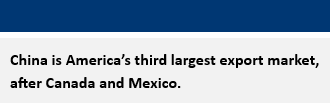
As the second-largest economy in the world, China’s consumer base continues to expand. Chinese businesses and consumers are buying numerous American goods and services, making China one of the biggest buyers of U.S. exports. In 2023 alone, U.S. goods exports to China were valued at approximately $145 billion, ranging from high-value products like aircraft and semiconductors to everyday items like soybeans, nuts and pork. The service sector generated another $42 billion in exports to China, particularly education and financial services, which are in high demand among Chinese businesses and families.
Midwestern states like Iowa and Illinois depend on the Chinese market for their crops—soybeans, corn, pork, and more—helping local farms and the communities around them. In manufacturing, states like Washington, Ohio, California, Texas and more rely on China as a destination for products such as aircraft and heavy machinery, creating thousands of well-paid jobs and fostering economic stability in those regions.
Job Creation and Economic Growth
The connection between U.S. exports to China and American jobs is significant. According to the Washington, DC based US-China Business Council* (a trade group of more than 270 American companies), nearly one million American jobs are tied to exports to China, spread across various industries and states. These are often high-paying, high-quality positions that provide families with financial security. In sectors like aerospace and automotive manufacturing, exports to China create jobs that are vital to keeping America’s industrial base competitive. Additionally, a strong export relationship with China drives innovation, helping American businesses stay at the cutting edge in an increasingly global economy.
States across the country benefit from these export-driven jobs. California, Texas, and Illinois, for example, all have strong trade ties with China, and businesses in these states rely heavily on Chinese consumers to buy their goods. The diversity in job creation across different states highlights just how essential the Chinese market is for sustaining the economic well-being of U.S. communities.
Why the United States Needs to Carefully Consider Tariff Policies
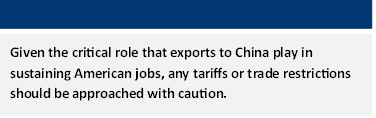
US Exports to China, report published 2024 by the US-China Business Council
Over the past few years, both the U.S. and China have imposed tariffs on each other’s goods, creating business uncertainty and threatening jobs in sectors that rely on a stable trade relationship. While tariffs are often meant to protect domestic industries, they can backfire when they lead to retaliatory tariffs that directly impact American exporters.
When China imposes tariffs in response to U.S. trade policies, the consequences are real and immediate for American farmers, manufacturers, and service providers.
Take the agriculture sector, for example—American farmers face an uphill battle selling their crops at competitive prices when Chinese tariffs make U.S. products more expensive. Similarly, U.S. manufacturing and service sectors lose out when demand in China shrinks due to higher prices on American goods.
Tariffs can disrupt local economies and lead to layoffs, income losses, and a drop in America’s global competitiveness. That’s why it’s essential for U.S. policymakers to strike a careful balance. Addressing legitimate trade concerns should not come at the cost of jeopardizing the jobs and economic stability that U.S. exports to China provide. Rather than increasing tariffs, the U.S. could explore options like direct negotiations to settle trade disputes in ways that protect American jobs without igniting a cycle of retaliatory tariffs.
Conclusion
The importance of China as a market for U.S. exports cannot be overstated. Exports to China support hundreds of thousands of American jobs and drive economic growth across a range of sectors. Organizations like the American World Trade Chamber of Commerce (AWTCC) play a vital role in ensuring that American exporters can navigate the complexities of international trade, providing essential services like Certificates of Origin and document certification.
While there are valid concerns about certain trade practices, the imposition of tariffs must be approached with caution. Retaliatory measures from China could put many American jobs at risk, damaging industries that depend on strong trade relationships with China. As the U.S. moves forward in its trade policies, it’s crucial to protect the benefits that exports to China bring to the American economy—especially the jobs that sustain American families and communities across the nation.
About American World Trade Chamber of Commerce (AWTCC)
Behind the scenes, organizations like the American World Trade Chamber of Commerce (AWTCC) play an essential role in making sure U.S. exporters can successfully access international markets such as China, simplifying the export process by supporting documentation required by foreign government agencies and Customs authorities.
Navigating the legal requirements and documentation for exporting goods to China can be a complex and challenging process, and that’s where the American World Trade Chamber of Commerce (AWTCC) steps in to help. By working in through cooperation with the International Chamber of Commerce (ICC) in Paris with key Chinese organizations like the China Council for the Promotion of International Trade (CCPIT) and China Customs, AWTCC makes it easier for American companies to meet necessary regulatory requirements to access the Chinese market. We issue documents such as ICC Accredited Certificates of Origin and legal document certification/Apostilles.
Exporters are able to get started today by registering here.
To keep up to date ensure you do register with us and follow us on LinkedIn.